Physical Address
304 North Cardinal St.
Dorchester Center, MA 02124
Physical Address
304 North Cardinal St.
Dorchester Center, MA 02124

Life and work challenge us in ways we often don’t see coming. Some days you feel motivated, focused, and in control. On other days, stress, self-doubt, and constant pressure can make even simple tasks feel overwhelming. This is where mindset mastery becomes essential.
Building mental strength does not mean forcing yourself to be strong all the time. It means learning how to stay emotionally balanced, recover from setbacks faster, and continue moving forward when situations become difficult. A strong mindset helps you manage stress more effectively, improve decision-making, and remain confident in both personal and professional situations.
In this practical guide, you will learn how to develop mental strength, strengthen your mindset for daily challenges, and create healthier habits that support long-term success at work and a more calm, focused, and fulfilling life.
People casually mix up motivation, discipline, and mental strength as if they’re interchangeable. They’re not.
Motivation and discipline are often confused with mental strength, but they serve very different roles.
Think of motivation as the spark that helps you begin. It creates short-term excitement and pushes you to take action.
Discipline helps you stay consistent by following routines and commitments.
However, mental strength is what keeps you stable when both motivation and discipline start to fade.
The real challenge appears when you feel mentally exhausted, when progress is slower than expected, and when your effort does not seem to bring immediate results. In those moments, mental strength allows you to stay focused, manage frustration, and continue moving forward without losing confidence.
Developing true mental conditioning requires more than quick inspiration. It is built through intentional habits, structured personal development, and supportive systems that help you strengthen emotional control, positive thinking, and adaptability. Over time, these practices improve psychological endurance and help you respond more effectively to pressure, change, and uncertainty.
Many people unintentionally slow their own growth by:
These patterns quickly lead to stress and burnout.
Instead of searching for motivation highs, focus on building real mental capacity—your ability to stay calm under pressure, recover from setbacks, and remain consistent without emotional exhaustion. This shift helps you develop the habits and mindset that allow you to perform well under load, while others struggle to cope with rising demands.
Mentally strong individuals are not defined by emotional coldness or rigid behavior. Their strength comes from trainable skills that anyone can develop with consistent practice.
Some of the most important traits include:
To begin strengthening your mindset, choose just one trait—such as emotional control or recovery after failure—and practice it intentionally for the next two weeks. Small, focused effort creates noticeable mental and emotional shifts.
Building mental resilience becomes easier when you follow a simple and repeatable process:
This loop strengthens mental resilience by turning awareness into real behavioral change.
A practical way to start is with a five-minute daily routine:
Over time, this process reshapes the internal stories that influence your confidence, decisions, and performance—helping you build a mindset that supports growth instead of holding you back.
The way you talk to yourself quietly shapes every result you get.
If your inner voice says, “I’m just not good at this,” you are more likely to avoid practice and give up early.
When you shift the message to “I’m learning and improving,” you naturally stay engaged longer and try again.
This is the foundation of a growth mindset for success—not ignoring difficulty, but interpreting challenges in a way that keeps you moving forward.
A fixed mindset usually shows up in simple, automatic thoughts such as:
A powerful replacement is a small language shift:
Instead of:
“I’m terrible at this.”
Try:
“I’m not there yet. What should I practice next?”
This single change helps your brain move from judgment to problem-solving.
When a setback happens, use this short reflection format:
Initial thought → New perspective → Immediate next step
Write it down. Turning your reactions into a visible process strengthens your growth mindset and improves follow-through.
Many projects fail not because people lack ideas, but because execution breaks down under pressure.
Progress depends heavily on how you mentally interpret obstacles. When challenges feel like proof of failure, consistency drops. When they feel like feedback, effort increases.
This is why rewiring your thinking around setbacks directly supports long-term success.
Positive thinking alone is not enough. Sustainable change happens when your identity supports your goals.
Instead of saying:
reframe it as:
Create three short identity statements that connect to real behaviors, such as:
When your identity aligns with your actions, your growth mindset becomes automatic rather than forced.
Mistakes are not failures. They are usable information.
After any stressful or challenging situation, take three minutes to run a quick review:
This short habit dramatically increases learning speed. The faster you extract lessons, the faster your skills improve. Over time, this creates a strong advantage in both personal development and professional performance.
Mindset shifts build the foundation for progress. But real mental strength develops when you gradually place yourself in manageable pressure situations, reflect on the outcome, and return stronger—without pushing yourself into exhaustion or burnout.
Mental toughness is not about pushing yourself to exhaustion. It is about building resilience in a structured and healthy way, so you can perform well under pressure without damaging your energy, focus, or well-being.
The most effective approach combines gradual challenge with confidence built from real results.
One of the safest ways to build mental toughness is through controlled and progressive exposure to stress.
Create a simple pressure ladder:
For example, you might first share your opinion in a small team discussion before preparing to speak in front of senior leadership. Scheduling just 10 to 20 minutes per week for intentional practice helps your nervous system learn that pressure is manageable rather than threatening.
This gradual exposure improves emotional regulation and reduces automatic panic or avoidance responses.
Lasting confidence does not come from positive quotes or temporary excitement. It comes from proof.
Start a personal progress log where you record:
Create a daily “minimum win” target—one small action that clearly moves you forward. Over time, this record becomes visible evidence of growth. Your confidence increases naturally because it is supported by real behavior and results, not self-talk alone.
Strategic planning creates a strong structure, but real mental toughness depends on your ability to respond during pressure itself. This means developing simple, reliable tools you can use in the moment—when stress is high and time is limited—not only when you reflect calmly afterward.
When pressure rises suddenly, you do not need theory. You need simple tools that work in real time. A strong mental resilience toolkit helps you regain control of your emotions, protect your attention, and recover quickly—without disrupting your workflow.
One of the fastest ways to calm your nervous system is controlled breathing.
Use one of the following techniques and practice it consistently:
Physiological sigh
Box breathing
Choose one method and link it to your most common stress triggers, such as:
Practicing the same technique in the same situations trains your body to calm down faster and prevents emotional reactions from taking over your decisions.
Emotional control helps you stay grounded. But without strong attention control, even a calm mind can become distracted and mentally stuck.
To protect focus and reduce decision fatigue, use short and structured work sessions.
Complete two focused 25-minute sessions each day.
During each session:
At the end of each session, perform a short shutdown routine:
This simple ritual strengthens concentration and preserves mental energy without requiring extreme productivity systems.
You now have practical tools for emotional regulation and attention control.
The next step is learning how to apply these skills in real workplace situations—tight deadlines, difficult feedback, interpersonal tension, and leadership pressure—so your mental resilience supports performance, not just calm.
The workplace is one of the toughest arenas for mindset mastery. Deadlines, feedback, and interpersonal challenges continuously test your mental strength—and how you respond determines your performance and professional growth.
When time pressure builds, clarity is your strongest ally. Use an “Impact × Urgency” matrix to prioritize daily tasks:
This approach ensures deadlines motivate action rather than trigger panic. Remaining calm under time constraints is a skill you can train, just like physical endurance.
Absorbing feedback without defensiveness requires a different kind of mental steadiness. Treat feedback as valuable information, not a personal attack.
Use this five-sentence framework when receiving critique:
This structure helps you stay composed, focus on actionable improvements, and reinforce a growth mindset for success—transforming criticism into progress rather than stress.
By combining prioritized action under deadlines with composed response to feedback, you build resilient performance habits that thrive under workplace pressure.
Mindset mastery isn’t reserved for elite athletes or executives. Mental strength is a skill anyone can develop with consistent, deliberate practice.
By identifying your personal triggers, training emotional regulation techniques, applying these skills under real pressure, and intentionally recovering afterward, you create a mental resilience system that holds up even in life’s most chaotic moments.
The benefits are tangible: you make clearer decisions, manage stress without breaking down, and keep moving forward even when progress feels slow or invisible. The real difference between knowing what to do and actually doing it consistently comes down to mental strength.
Start small—pick one habit to practice today. Over time, your future self will thank you for the foundation you’re building now.
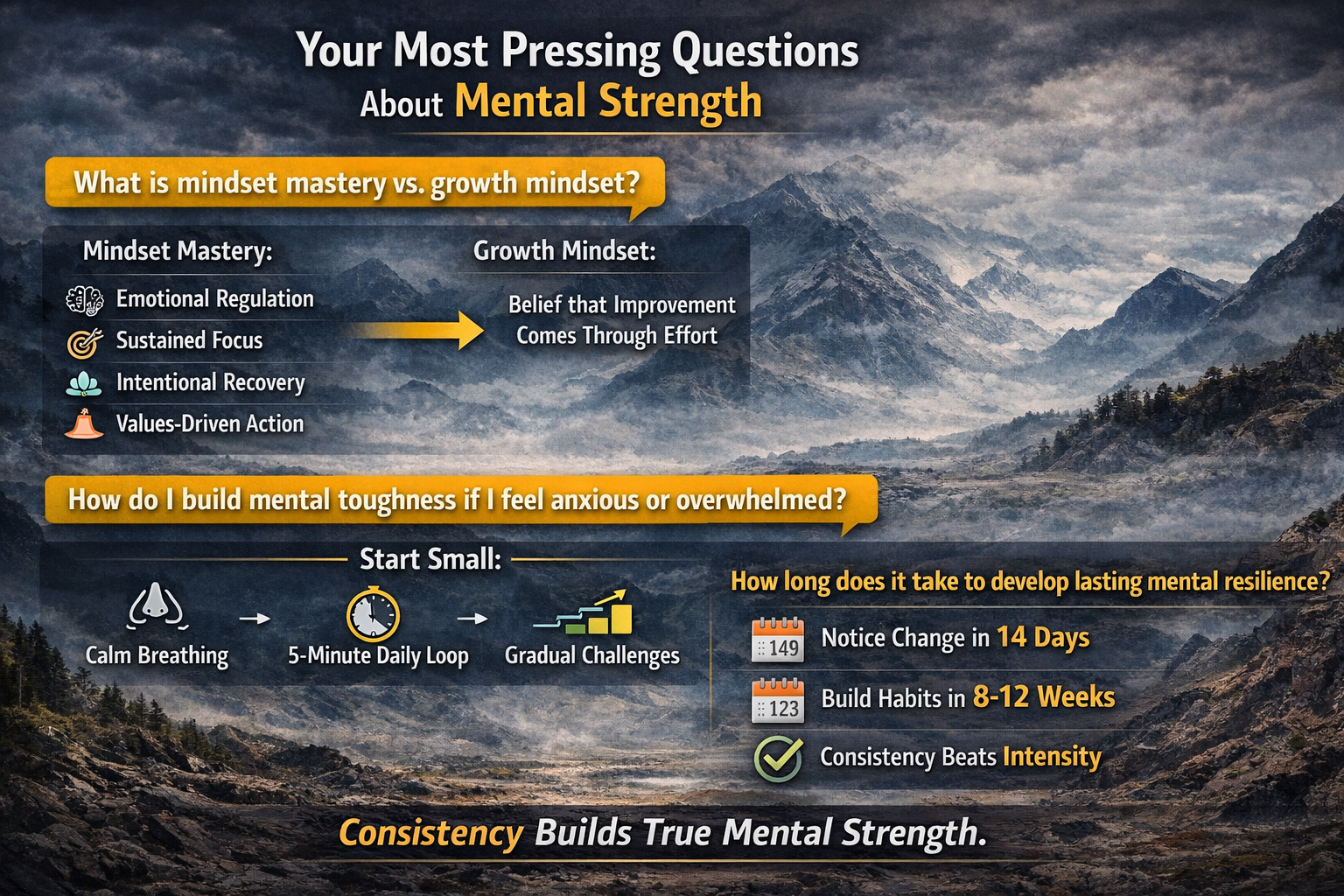
1. What is mindset mastery, and how is it different from a growth mindset?
Mindset mastery includes emotional regulation, sustained focus, intentional recovery, and values-driven action. A growth mindset is one part of this—it’s the belief that improvement comes through effort. Mastery takes that belief and embeds it into daily habits and practical systems that guide real behavior under pressure.
2. How do I build mental toughness if I feel anxious or overwhelmed?
Start small. Use one reliable breathing or calming technique whenever stress appears. Pair it with a five-minute daily loop: identify a trigger → practice a skill → briefly reflect. Gradual, consistent practice builds capacity safely, while extreme challenges too soon can backfire.
3. How long does it take to develop lasting mental resilience?
You may notice small improvements within two weeks of consistent effort. True, sustainable resilience usually develops over 8–12 weeks, as habits become automatic. Remember: consistency beats intensity. Track weekly progress to reinforce gains and adjust strategies that aren’t working.